Showing posts with label Exhibition Review. Show all posts

October 24, 2015

28 Chinese at San Antonio Museum of Art

I recently visited the San Antonio Museum of Art to view the 28 Chinese exhibition of contemporary Chinese art from the Rubell Family Collection. This collection was amassed by the Rubells over the course of 11 years and involved them personally traveling to China, visiting hundreds of artist's studios, and trusting that the work they purchased would make its way safely across the ocean. 

When the Rubells travelled to China, a gallery system as we know it in the United States was non-existent. Even today, it's a relatively new idea in the Chinese contemporary art world. However, through their visits, the Rubells were building relationships and establishing the trust of those artists whose work they admired and chose to collect. 

As the Rubells explained in their talk with curator Anna Stothart, the artists often wanted to ensure that the work they sold would be going to a good home. They had a hard time parting with their work and wanted for it to be appreciated and cared for, rather than treated as an investment or commodity. The way the Rubells spoke about this collection and the artists shows how truly passionate they are and how they are living up to that trust they established. 

It was fascinating to hear the Rubells speak about their love for collecting art - something that Donald Rubell described as a "collector gene." They discussed how they establish themes for collecting and focus on those for a certain amount of time. In doing so, The Rubell Family Collection has amassed impressive and important Contemporary art from all over the world. They started it in 1964 with a $25 a month budget and grew it to the current collection housed in their 45,000 square foot warehouse in Miami, Florida. Yet, they continue to grow their collection, and they revealed that their next theme is a collection of Women Artists. 

Going in to this exhibition, the only Chinese artist that I was familiar with was Ai Wei Wei, but when I left, I was eager to learn more about so many artists whose work I encountered. 

Ai Weiwei, Ton of Tea, 2005, Photo by Stephanie Torres
In Wei Wei's piece, Ton of Tea, tea leaves have been compressed into a massive cube. The tea he used is Pur'er, one that is consumed most commonly throughout China and that was traditionally pressed into small blocks to be exported. Here, Wei Wei is commenting both on globalization and the growing Chinese population. 

Huang Yong Ping, Well(s), 2007, Photo by Stephanie Torres
There are a number of interactive pieces in this exhibition including these three large traditional Chinese vases or "wells" by Huang Yong Ping. The viewer is asked to peer into each one and discover what's hidden inside. I won't spoil the surprise, but they each contain objects that are symbolic, and whose symbolism can vary from culture to culture.

Qiu Zhijie, Memorial for Revolutionary Speech, 2007, Photo by Stephanie Torres 
Qiu Zhijie, Sixteen ink rubbings and cement cube, Photo by Stephanie Torres
Qui Zhijie's Memorial for Revolutionary Speech depicts various slogans from revolutionary speeches made throughout China's history. Zhijie carved slogans onto a cement block using the calligraphic style from each era and used them to make the ink rubbings that are on display. The prints capture the evolution of Chinese calligraphy and the history of revolutionary thought. The cement block was built up by pouring cement over each carving to make the surface for the next one, thus concealing the previous slogan. 

Qiu Zhijie, I Used to Have 72 Forms, 2009 (Foreground), TATTOO -2, 1994 (Background) Photo by Stephanie Torres
Another piece by Zhijie incorporates functional bamboo objects that were once used for every day tasks, like cooking or storage. They have been woven onto a bamboo mat, rendering them useless, but thereby turning them into symbolic sculptures. 

Zhu Jinshi, Boat, 2002, Photo by Stephanie Torres
Boat is another one of the interactive works of art in this exhibition. This massive hanging sculpture was made using thousands of sheets of rice paper. Museum staff put it together over the course of several days by folding and layering the paper on the bamboo structure. The audience can walk through the center of Boat and experience a symbolic journey that seems to block out the rest of the world.  

Zhu Jinshi, Epoch Color, 2010, Photo by Stephanie Torres
In Zhu Jinshi's massive, almost sculptural painting, Epoch Color, the artist has layered excessive amounts of oil paint on to the canvas using shovels and trowels. The extremely thick layers take years to dry and the painting evolves slowly as the paint cracks, breaks, and slides around the canvas. 

Lan Zhenghui, Untitled, 2008, Photo by Stephanie Torres
Lan Zhenghui's untitled abstract painting references modern influences like Franz Kline and the Abstract Experisonsts, while using traditional Chinese ink and rice paper. The works are in line with the Chinese landscape painting tradition in which the painter's expression of nature was a meditative experience.

Li Shurui, I am not ready..., 2013, Photo by Stephanie Torres
This painting by Li Shurui explores the Urban landscape through abstraction. She used airbrush to create a series of paintings based on photographs of LED screens, exploring the relationship between light and space. 

Chen Wei, Honey in the Broadcast, 2008, Photo by Stephanie Torres

Photographer Chen Wei creates a sense of alienation and disorientation in his photos by  constructing intricate sets that are often small, confining spaces and include a solitary figure.

He Xiangyu, The Death of Marat, 2011, Photo by Stephanie Torres

Conceptual artist, He Xiangyu creates a moment of temporary shock for the viewer as they encounter his life-like resin sculpture depicting the corpse of artist, Ai Wei Wei. Xiangyu elevates Wei Wei to a tragic figure by referencing the title of the Neoclassical painting by Jacques-Louis David that shows the murdered French revolutionary, Jean-Paul Marat. 

The work featured in 28 Chinese is just a sampling of the amazing work the Rubells have collected. It spans six galleries and two floors in the San Antonio Museum of Art and is organized into a variety of themes, from Social and Political Activism to Abstraction.

28 Chinese is on view at the San Antonio Museum of Art until January 3, 2016.

June 21, 2015

Lesley Dill: Performance as Art

Paper Poetry Scroll Suit from Divide the Light "Banish air from air - divide light if you dare." Emily Dickinson
The McNay Art Museum is currently hosting an exhibition that showcases the performance work of Contemporary artist, Lesley Dill. The costumes on display were used in the numerous performance projects that Dill has conceived and performed over the past twenty years. A large part of the exhibition includes the costumes for Divide Lightthe full-scale opera that Dill wrote and directed in 2008. Dill's work examines the relationship between the human body and the written word, and she specifically incorporates the poems of Emily Dickinson into these pieces.

Even when viewed on their own, outside of the context of the performance, the garments are quite evocative. The Paper Poetry Scroll Suit from Divide Light was constructed of book pages onto which Dill then painted the lines from the poem. Other dresses have cascading scrolls of fabric, or dramatic trains with words embroidered on them. They are enigmatic, haunting, and even with their theatricality, there is a sense of vulnerability exuded from these garments.

The exhibition includes excerpts from the performances in which these costumes were used, and it adds a whole other dynamic to the work, as they are brought to life in the performances and can be appreciated in the context they were created for. 

Lesley Dill: Performance as Art is on view at the McNay Art Museum until September 6, 2015. 

Detail of Paper Poetry Scroll Suit from Divide Light

To Be Alive is Power (Apron Dress) from Divide Light 
Dada Poem Wedding Dress, 1994
Red Thread Fall, 2003 "Take all away from me, but leave me ecstasy." Emily Dickinson 

March 14, 2015

Parallels | Hello Studio

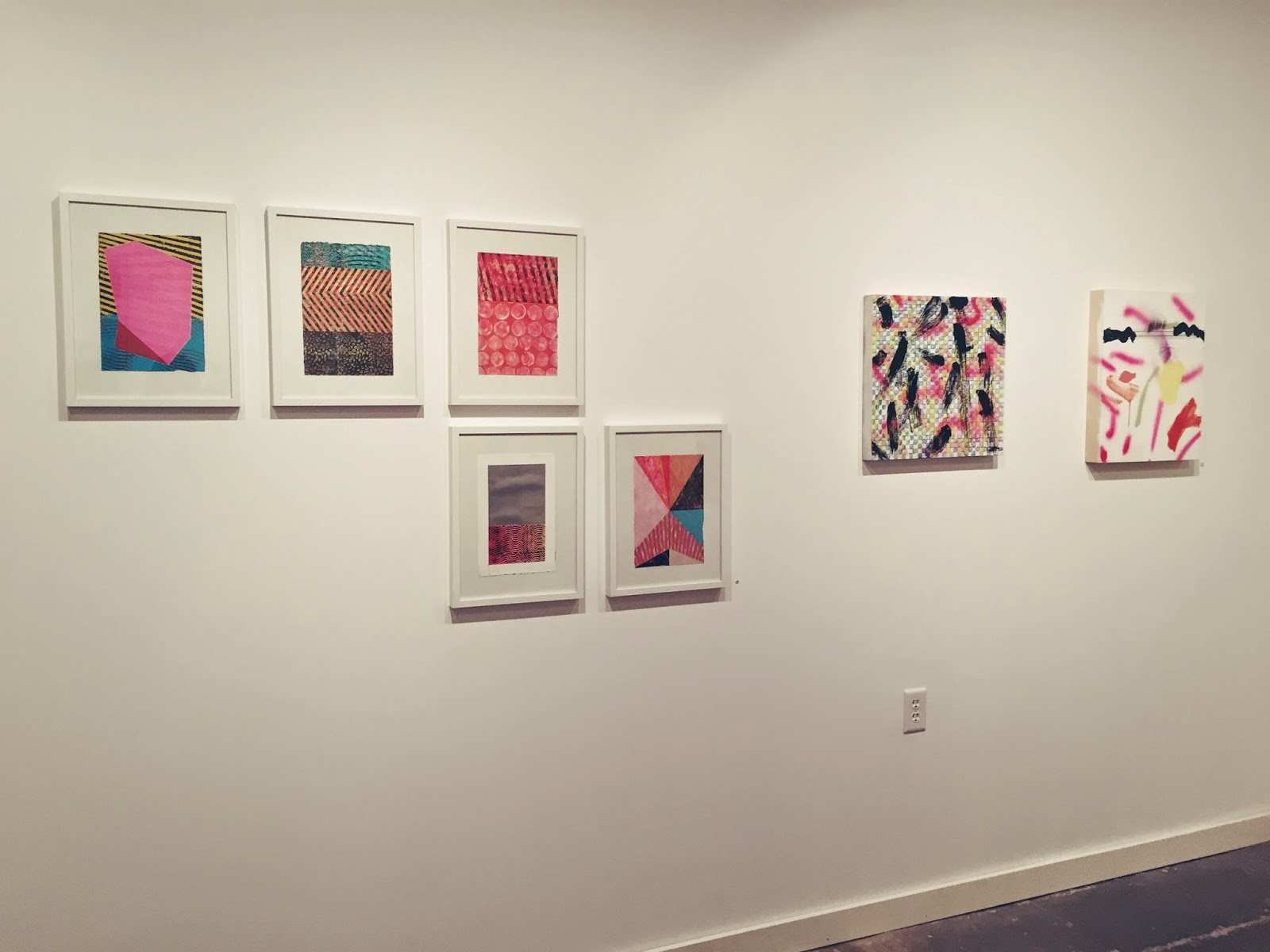
View of Cande Aguilar's Untitled 6 (left) and Christie Blizzard's Without You I Have No Mirror (right). Photo By Stephanie Torres. 
Hello Studio’s exhibition for Contemporary Art Month, Parallels, highlights several artists whose work is similar in its non-representational style, yet varied in how each explores color, line, shape and composition.
The painterly abstraction of artists Cande Aguilar, Jorge Puron, and Sarah Frey is driven by an expressive use of color and dynamic mark-making, while works on paper by Jennifer Sanchez and Xochi Solis explore a more subtle approach in their use of vivid color and layered textures. Casey Deming and Kristy Perez focus on shape and line with their minimalism and muted palettes.

Overall, the show is a visually stimulating experience: bringing together emerging artists whose work reflects the expressive nature of these basic design elements on an intimate scale.

Parallels exhibition currently on view at Hello Studio. Photo By Stephanie Torres. 
View of works by Jennifer Sanchez (left) and Sarah C. Frey (right) 

Sarah C. Frey, Studio Apt. Photo By Stephanie Torres

Kristy Perez, Wabi-Sabi Series 1 - 10. Photo by Stephanie Torres
View of collages by Xochi Solis. Photo By Stephanie Torres

March 8, 2015

Cornelia White Swann | Fugitive Color I

Cornelia White Swann, Brewster on the Horizon, 2015, Purple Cabbage, blueberry, henna on paper on display at Fugitive Color I, French and Michigan Gallery, Photo by Stephanie Torres
 
In her new series of works on paper, Cornelia White Swann explores the use of natural pigments and reflects on how that process challenged the way she was accustomed to working and how she accepted the evolution of the work before her. 
View of Cornelia White Swann's works on paper currently on view at Fugitive Color I, French and Michigan Gallery, Photo by Stephanie Torres
Swann has previously worked with synthetic material that was permanent, archival and that was meant to maintain its color over time. Light-fastness is a very important consideration for artists, and as Swann noticed how the naturally derived pigments she was working with changed over time, this unnerved her. However, she realized that for this series she needed to let go of that desire for permanence and instead, “accept the process…[and] the fugitive nature of this color.” This realization led to the work that is on display in this exhibition, as she let the process and the materials guide her creating.

View of Cornelia White Swann's works on paper currently on view at Fugitive Color I, French and Michigan Gallery, Photo by Stephanie Torres
These intimate works on paper are Swann’s initial explorations into working with the pigments she hand-made from fruits, vegetables, flowers, plants, and herbs. The varying shades of color flood the paper with the surprisingly golden hues derived from red onions, or the greenish tone produced by red cabbage. There were also lovely shades of magenta and bluish-violet from hibiscus, pinkish coral from henna, and bluish-grey from elderberry. Visually reminiscent of color field paintings, like those by Mark Rothko or Helen Frankenthaler, these pieces have a serene and meditative quality.

View of Cornelia White Swann's solar dye jars currently on view at Fugitive Color I, French and Michigan Gallery, Photo by Stephanie Torres
Also included in this exhibition is a group of solar dyeing jars each filled with water, a plant or herb, and a rolled up sheet of paper. These jars will be exposed to the sun for a period of time, and the natural dye will adhere to the submerged sheet of paper. The end result will depend on the length of time and the type of natural pigment used. Some of the works that derived from this process are on display and are particularly striking. The resulting monochromatic layers are reminiscent of eerie landscapes.

View of Cornelia White Swann's works on paper currently on view at Fugitive Color I, French and Michigan Gallery, Photo by Stephanie Torres
Swann plans to document the natural evolution of these works and how they change over time, with a follow up exhibition planned for 2016.  

Fugitive Color I is on view through April 25, 2015 at French and Michigan.

August 10, 2014

Matisse: Life in Color

View of Henri Matisse's Purple Robe and Anemones (1937) currently on view at the San Antonio Museum of Art. Photo By Stephanie Torres.

The Matisse: Life in Color exhibition currently on view at the San Antonio Museum of Art features more than 80 works of art by Henri Matisse, one of the most important Modern artists of the twentieth-century.

View of Henri Matisse's Young Woman at the Window, Sunset (1921) currently on display at The San Antonio Museum of Art. Photo By Stephanie Torres.
As one of the founding members of les Fauves ("the Wild Beasts"), Matisse was known for his use of explosive non-natural color and blunt brushwork in creating his bold canvases.  In 1905, Matisse, along with several other avant-garde artists, exhibited work in the Salon d' Automne, an exhibition that was organized in response to the conservative policies of the official Paris Salons. 

View of several of Henri Matisse's paintings currently on display at The San Antonio Museum of Art. Photo By Stephanie Torres.
It was at this exhibition where Claribel and Etta Cone, two wealthy, educated, and independent sisters from Baltimore first encountered Matisse's work. They bought their first Matisse painting this same year and would go on to collect over 500 works of art by Matisse over the next 40 years.

View of Henri Matisse's Arabesque (1924) currently on display at The San Antonio Museum of Art. Photo By Stephanie Torres.
The Cone Collection is remarkable, not only for how prolific it is, but also for personal it feels. The Cone sisters loved art and were collecting paintings, drawings, and sculptures that they wanted to display in their home and surround themselves with. This is the art they lived with and interacted with on a daily basis: having meals, entertaining, and relaxing amongst it. 

View of Henri Matisse's Still Life, Bouquet of Dahlias and White Book (1923) currently on display at The San Antonio Museum of Art. Photo By Stephanie Torres.
Even from just this small sampling of their collection, you feel like you're getting to know them as well. It is especially interesting that these two conservatively dressed, Victorian ladies were inspired to collect such colorful, innovative, and shocking work. They might not have been able to express this sensibility in their own appearances, but it's apparent they were drawn to something in the exotic textures and patterns,  intensive colors, and the joy of life expressed in Matisse's stunning canvases.

View of Henri Matisse's Girl Reading, Vase of Flowers (1922) currently on display at The San Antonio Museum of Art. Photo By Stephanie Torres.
The Cone sisters collected art because they had time, money, and a passion for it. They filled each of their homes from floor-to-ceiling with it, and even rented an additional apartment when both of their spaces were filled to the brim. In their lifetimes, these two women amassed a collection of 3,000 works of art from some of the most important avant-garde artists of the twentieth century, including not only Matisse, but also Picasso, Gauguin, van Gogh, among others. Most of the artists were not famous when the Cone sisters began collecting them, so it is evident that their love of art went beyond the aesthetic, and they were very much attuned to the importance of these Modern art movements.

Matisse: Life in Color is on view at the San Antonio Museum of Art until September 7th.

July 31, 2014

Jenelle Esparza: Ancestral Archetypes

Jenelle Esparza, Speaking in Blooms (2014), archival pigment print. 
This weekend is the last opportunity to view Jenelle Esparza's photography exhibition, Ancestral Archetypes at Blue Star. If you haven't already, I highly recommend you do. 

View of Jenelle Esparza's Ancestral Archetypes exhibition currently on view at the Blue Star Contemporary Art Museum in San Antonio, TX. Photo by Stephanie Torres.  
I loved this work because it was reminiscent of Victorian portraiture in the way that Esparza explored the use of the silhouette and for the ethereal quality of images themselves. 

It was also impressive and refreshing to see that Esparza created these images using a medium format film camera and superimposed multiple exposures of the sitter and the natural surroundings around their homes on the negative to create the haunting and dreamy images. 

Jenelle Esparza, Where Love Invents Worlds (2014), archival pigment print. 
Jenelle Esparza, Through the Depths of a Desert (2014), archival pigment print.
The photographs do not represent a specific person or their likeness, yet they evoke a feeling of comfort and familiarity. They remind us of our own ancestors and how our memories of them are often linked to not only what they looked like, but how their belongings and their spaces made us feel. Perhaps we also relate to the images ourselves because of how we identify with the things that surround us and connect to this world.

View of Janelle Esparza's Ancestral Archetypes exhibition currently on view at the Blue Star Contemporary Art Museum in San Antonio, TX. Photo by Stephanie Torres.
Ancestral Archetypes is on view at Blue Star Contemporary Art Museum until August 3rd


July 29, 2014

Beauty Reigns: A Baroque Sensibility in Recent Painting

Beauty Reigns: A Baroque Sensibility in Recent Painting brings together thirteen abstract painters whose beautiful, fascinating, and sometimes, strange work is a refreshing departure from the minimalist tendencies often found in contemporary art. 

According to the press release, with this exhibition, curator Rene Paul Barilleaux, wanted to highlight the "exoticism, exuberance, and optimism" in the work of the artists he selected. Additionally, these artists work in a style that is "characterized in whole or part by high-key color, obsessive layering of surface imagery, use of overall and repeated patterns, stylized motifs, fragments of representation, and a tension between melancholy and the sublime." 
View of Susan Chrysler White's Medusa (foreground) and Rosalyn Schwartz's paintings at the McNay Art Museum. Photo By Stephanie Torres.
Susan Chrysler White's floor-to-ceiling plexiglass chandelier, Medusa, is a dramatic and elegant inclusion in this exhibition. Much like its mythic namesake, this Baroque-inspired sculpture commands the viewer's attention compelling them to look its way.


View of Kamrooz Aram's work at the McNay Art Museum. Photo By Stephanie Torres. 
Kamrooz Aram explores the beauty of floral motifs found on Persian carpets and pushes those traditional elements towards further abstraction. Aram creates these paintings through a repetitive process of building up the surface pattern, destroying it, and then building it up again. The end result is a dynamic, fragmented image that defies the viewer's perception of what decoration is meant to be. 

View of Rosalyn Schwartz's The Big Perfume at the McNay Art Museum. Photo By Stephanie Torres.
Rosalyn Schwartz explores the lush extravagance of interior design and draws upon Classical and Cubist elements in her abstracted still life, The Big Perfume. In it, two large liquid-filled urns sit atop a pair of pedestals and a bunch of loosely painted grapes appears in the flattened foreground. With this painting, Schwartz creates a subtle meditation on excess and the allure of decorative objects. 

The wide range of artists featured in this exhibition exemplify Baroque aesthetic tendencies, engaging the viewer not only with the beauty of their work, but also with the drama and excess that invariably elicits an emotional response from the viewer.


Beauty Reigns: A Baroque Sensibility in Recent Painting is on view at the McNay Art Museum until August 17th. 

January 14, 2014

Elizabeth Keithline: Smarter, Faster, Higher

It's been a while since I've been to First Friday, but this month I was intrigued by Elizabeth Keithline's Smarter, Faster, Higher exhibition currently on view at Blue Star Contemporary Art Museum
  
Elizabeth Keithline, Smarter, Faster, Higher

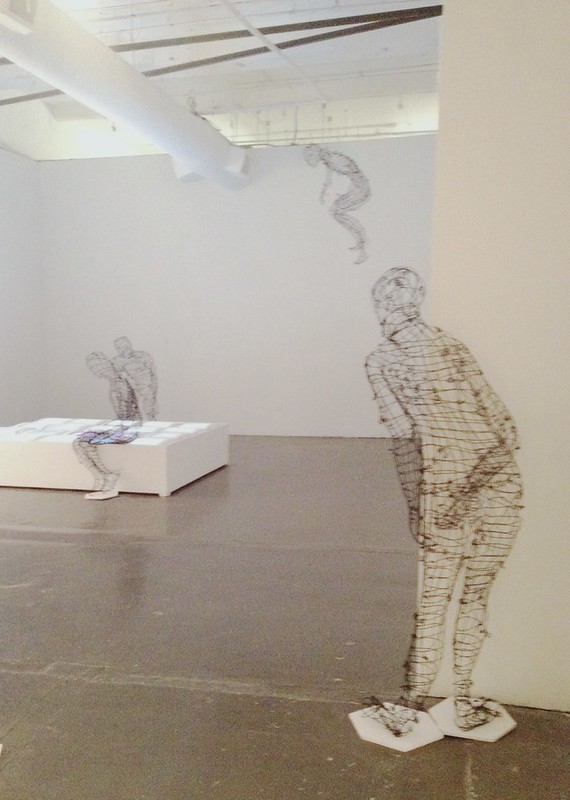
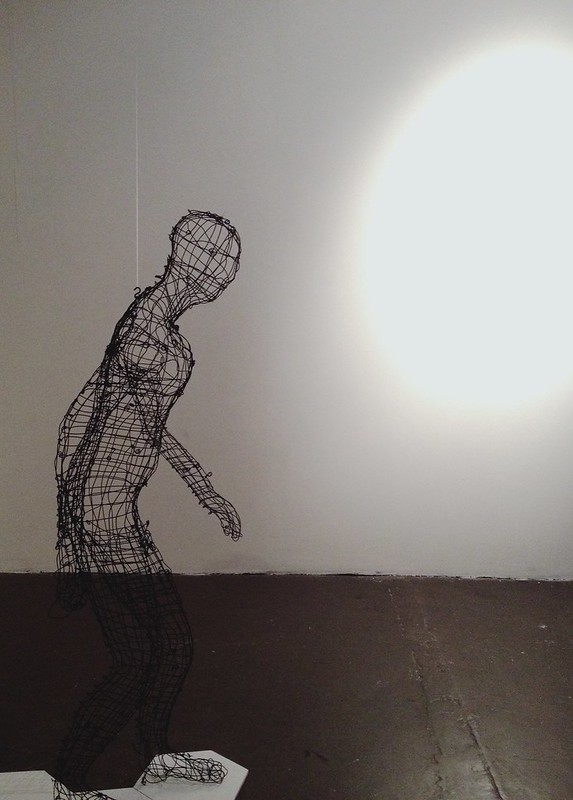
In this installation, Keithline's full-scale wire figures inhabit the gallery space. Some of the figures stand, others are curled up on the floor, and some crawl. There are two figures seated on the edge of the "pool" mesmerized by the images of figures, just like them, that are repeating on the screens. 

Elizabeth Keithline, Smarter, Faster, Higher

There is something about walking into the space that is unsettling, but playful at the same time. The figures are scattered throughout the stark white space and as you walk around, you interact with them and the eerie shadows they cast.  

Elizabeth Keithline, Smarter, Faster, Higher

The figures remind me of the mannequins often depicted in Giorgio De Chirico's metaphysical paintings, and how these wire statues are also featureless, expressionless substitutes for a human presence.

Elizabeth Keithline, Smarter, Faster, Higher


With this installation, Keithline explores the idea that technology, just like nature, evolves through repetition, constantly striving to become "smarter, faster, higher." This comes across in the way the figures are arranged in the room, with the less evolved figures - those that are curled up on the floor, crawling, or crouching - gathered amongst the wire trees. Whereas, figures that run, float in the air, or sit in contemplation of their own image, are set on the opposite side of the space, more isolated and distracted than the others.